
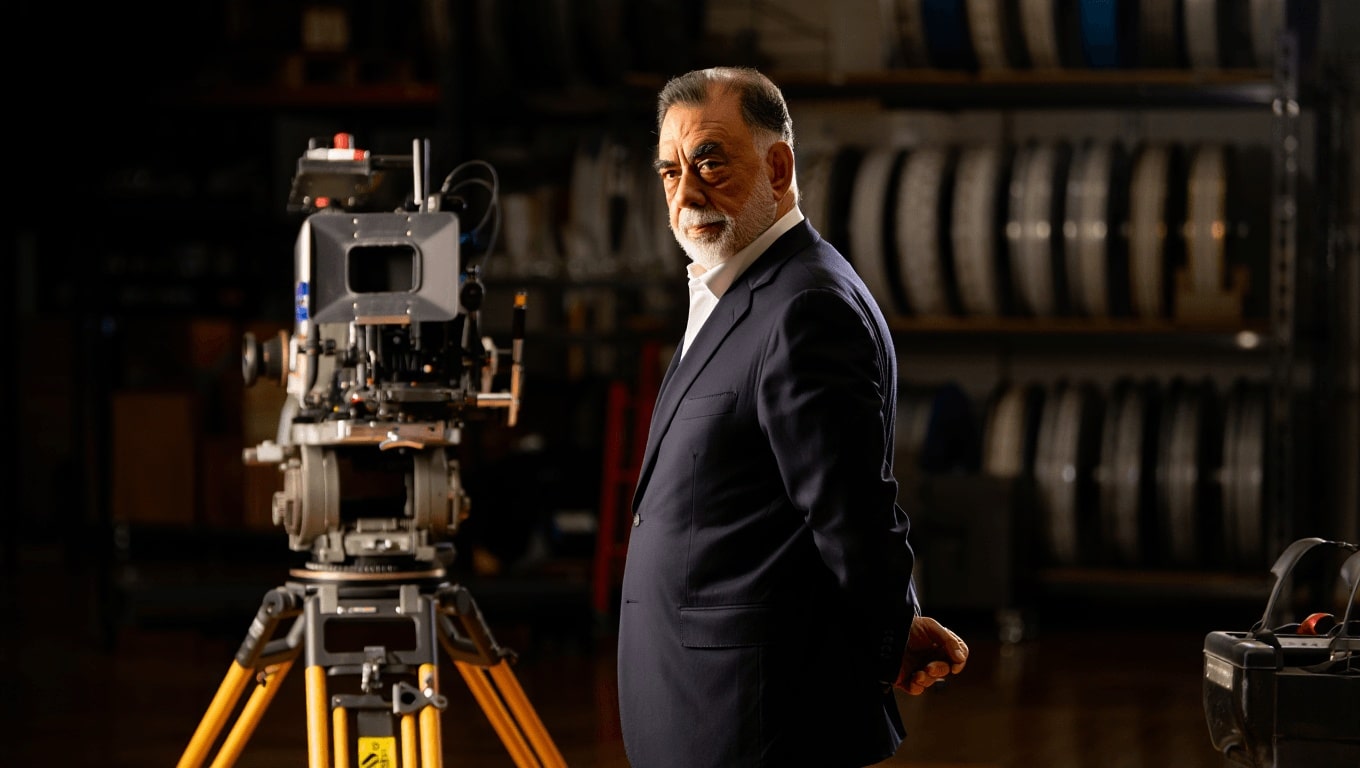
Production has begun on Thank You Mr. Brown, a feature documentary about Garrett Brown — the engineer and camera operator whose tools rewrote how movies move and feel. The film aims to trace his inventions and career at a moment when his work continues to shape cinema, television and live sports coverage.
Francis Ford Coppola is attached as an executive producer, joining Lauren Zarelli Renaud of C’est What Studio; Andrew Schwartz directs. EBE owners William Forbes and line producer Douglas Skinner are producing, with Nick Ditri serving as producer and music supervisor. Filming is currently underway in Philadelphia, New York and Los Angeles.
The project assembles firsthand testimony from colleagues and operators who used Brown’s devices on landmark productions. Among them is veteran Steadicam operator Larry McConkey, whose credits include Django Unchained, 12 Years a Slave and Shutter Island; he describes Brown’s machine as more than a technical breakthrough — a new storytelling tool.
Brown’s contributions to image-making are widely recognized within the industry. Over several decades he has collected major honors from the Academy, including an early award for the invention now known as the Steadicam, later accolades for flying-camera systems and other technical achievements. His rigs allowed filmmakers to stage fluid, extended moves without rails or cranes, enabling sequences that were previously impractical or impossible.
- Major inventions: Steadicam (body-mounted stabilizer), SkyCam/Skyman (flying camera systems) and the DiveCam (specialty aerial platform).
- Key awards: Academy recognition for the Steadicam (late 1970s) and subsequent technical and scientific honors for airborne camera systems (1999, 2006).
- Iconic uses: early work on Bound for Glory; long Steadicam passages in The Shining and Rocky; the speeder-bike chase in Return of the Jedi.
Director Andrew Schwartz, who has known Brown for many years, says the film will chart both technical innovation and the personal traits that drove it: curiosity, persistence and hands-on experimentation. EBE’s William Forbes frames the story as one of practical invention — a craftsman from Philadelphia whose devices altered motion pictures, television and live-event broadcasts.
Brown’s path to the Steadicam was incremental and practical rather than cinematic myth. He has described how a simple test rig assembled from plumbing parts and a handheld pole led to the first stabilizing prototype. That early experiment eventually matured into equipment that freed camera movement from the physical limits of dollies and tracks.
For filmmakers, the practical change was substantial: where smooth motion once demanded heavy tracked dollies and time-consuming setups, Brown’s stabilizers let operators carry camera movement over long takes and complex terrain. The result was new possibilities for staging, rhythm and audience immersion.
The documentary’s production team includes co-producers Kim Berrios Lin, Colin Geddes and Katarina Gligorijevic; interviews and on-location recreations are being shot where Brown worked and lived. The filmmakers have not yet announced a release date.
Why this matters now: as streaming platforms and event broadcasters continue to favor dynamic visuals, the historical arc of tools like the Steadicam and SkyCam explains how contemporary camera language developed. Thank You Mr. Brown promises to connect technical history with the people who used these inventions to invent new cinematic grammar.
Similar Posts
- Da Vinci Code sequel adds Rebecca Hall: Claire Foy, Matthew Macfadyen to lead You Are Here
- Tyler Perry Studios opens high-tech virtual stage in deal with Synapse
- NBC orders two comedies: Tea Leoni and Tim Daly front Newlyweds, Jake Johnson heads Sunset P.I.
- Discovery reality star amid reports of separation from wife
- Laura Dern, Heather Graham: new casting shakes up Epstein drama and The White Lotus

Hello, I’m Declan. I share my film reviews and discoveries with you to enrich your moviegoing experience.