
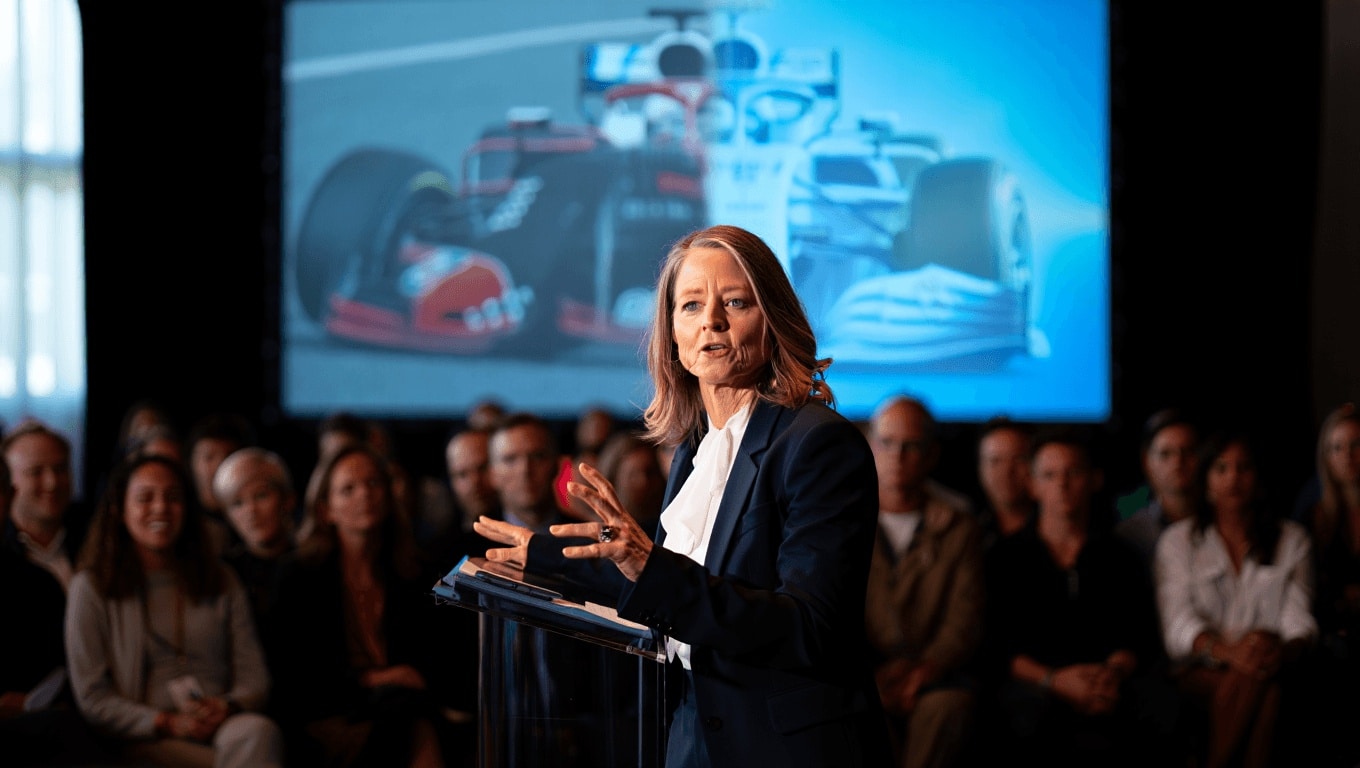
Jodie Foster says artificial intelligence is already woven into Hollywood’s methods — and she points to the high-profile racing film F1 as evidence. Her comments at a recent Aspen Ideas Festival session sharpen the debate over whether blockbuster filmmaking is being guided by human creativity or by generative tools.
During the panel titled “Who Owns the Future of Hollywood?” Foster suggested that the structure and delivery in films like F1 felt engineered, not purely improvised or traditionally authored. She framed her observation as a practical concern for the industry rather than a moral condemnation: the movie made large sums and drew major awards, yet its execution, she argued, bore the hallmarks of algorithmic design.
What Foster sees and why it matters
Her critique focused less on the film’s success than on the process behind it. Foster described scenes that followed textbook storytelling beats and performances that seemed to hit precisely the choices a model might select for maximum effect — an approach she believes could scale rapidly across other projects.
- Creative control: Foster warned that if machine processes set the defaults, distinct voices risk being flattened by predictability.
- Jobs and compensation: She expressed concern that AI could eliminate roles across the industry, and stressed the need for labor protections so artists are paid when their likenesses or work are reused.
- Practical uses: Foster acknowledged useful, non-creative roles for AI, such as storyboarding and pre-visualization, which can speed production without replacing authorship.
The comments did not dismiss all applications of AI. Foster recounted using generative tools on her upcoming 2025 French project, A Private Life, to create a dream sequence — an experiment she said produced striking, if sometimes nonsensical, imagery that ultimately worked on screen. She urged filmmakers to learn to “dominate” the technology so it serves their vision rather than dictating it.
Industry and policy in motion
Foster’s observations come as unions and policymakers wrestle with concrete responses. SAG-AFTRA has backed an administration policy framework that urges congressional action on issues from intellectual property to parental controls and workforce training. Separately, the White House has required a voluntary short review period for new AI models proposed by companies — a move meant to give regulators a look before wide release.
Those developments underscore a central tension: how to preserve creative labor and artistic distinctiveness while allowing studios and creators to use efficiency-enhancing tools. Foster suggested a pragmatic compromise — stronger protections that let artists profit when their work or likeness is reused, paired with responsible, limited uses of generative systems.
As studios chase scale and spectacle, the conversation Foster opened points to an immediate editorial question for readers and creators alike: who sets the defaults for storytelling, and how will policy and union rules shape the economics and aesthetics of the next era of filmmaking?
Similar Posts
- Sandra Bullock urges Hollywood to embrace AI: why actors and crews should care
- SZA, Kenneth Blume demand answers after AI scraped their music
- Hal Foster’s Tarzan: The Complete Sunday Comics collects 292 classic strips
- Civil War Unmasked issue 3 preview spotlights huge Goliath clash
- Black Americans in the Revolutionary War: GenAI-backed doc reclaims their stories

Hello, I’m Declan. I share my film reviews and discoveries with you to enrich your moviegoing experience.