
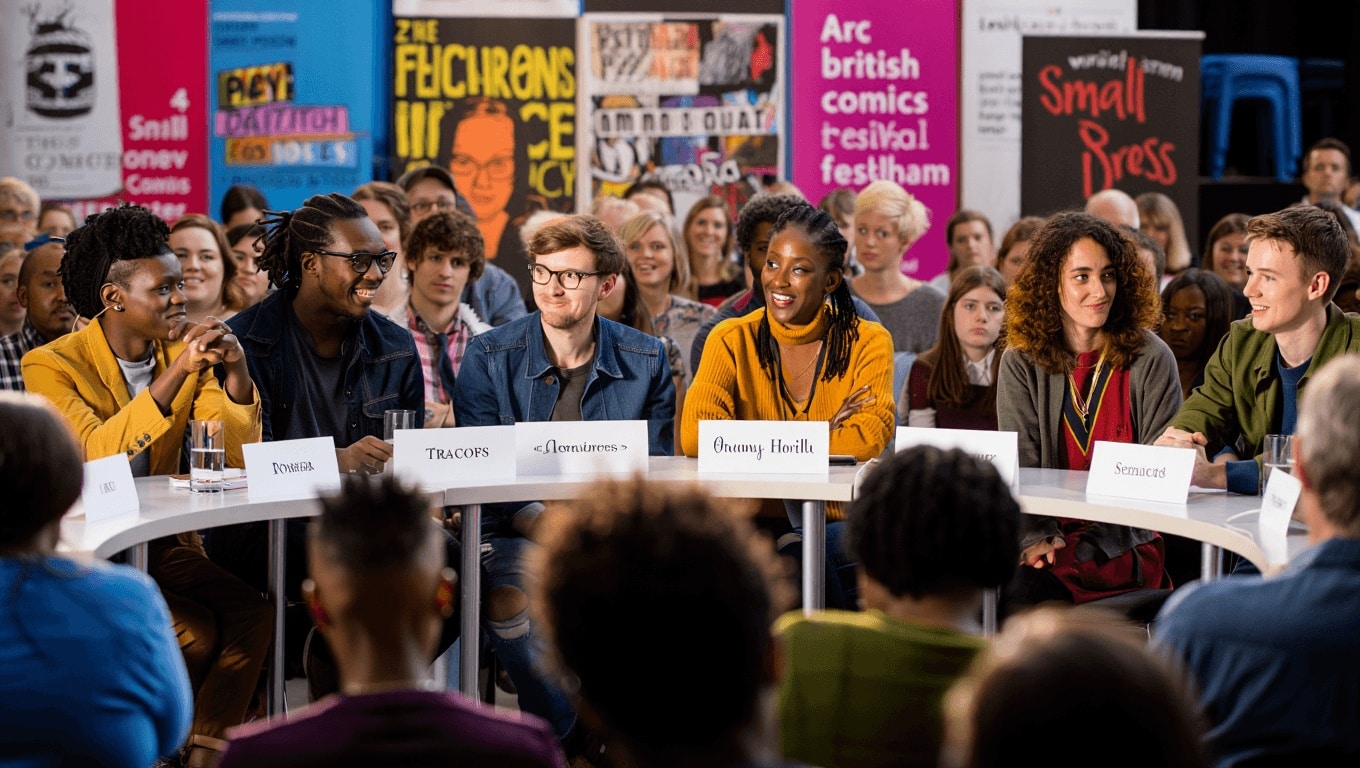
The ARC Contemporary Comics Festival in Peckham turned its spotlight on the often-overlooked legacy of UK small press this week, as a panel of writers, archivists and publishers traced how photocopiers, punk-era zines and DIY ingenuity reshaped British comics. Their discussion — part history lesson, part preservation warning — underlined why these fragile, home-made books still matter for readers, scholars and creators today.
The session at The Hub, chaired by Douglas Noble, brought together a cross-section of voices connected to the scene: curators, long-time self-publishers and the University of the Arts London archives. Conversation ranged from how grassroots distribution networks emerged to the practical difficulties of conserving ephemeral material whose makers never intended it to survive.
From a market gap to a movement
Paul Gravett described how early efforts to set up a local distribution point answered a practical need — people wanted access to new, experimental work without having to rely on mail-order from the United States. What began as a table at the London Comic Mart became a hub for a small press community, anthologies and later museum-level exhibitions. Gravett also noted institutional interest has grown: major collections, including holdings at national institutions, now preserve copies of titles that once existed in tiny print runs.
Ed Pinsent, who has self-published since the early 1980s, framed the scene around a simple technological shift: affordable photocopying plus postal distribution turned anyone into a publisher. He emphasized the immediacy and intimacy of that model — creators could reach readers directly and experiment with personal storytelling in ways mainstream outlets did not allow. Pinsent acknowledged the scene’s creative vitality while also reflecting on its historical blind spots, such as limited gender balance among contributors.
Dr Ian Horton, a long-time enthusiast turned archivist, recalled discovering international titles that felt like revelations and argued the availability of low-cost reproduction helped democratize comic-making. But he reminded the audience that a variety of reproduction methods coexisted, from simple photocopies to more traditional print processes.
Archiving fragile voices
Blanca Garcia Paja, who works in the UAL archives, described the practical challenges of conserving small press material: incomplete runs, brittle paper, lost staples and objects never intended for long-term survival. She stressed that curators aim to preserve the artefact as it exists, not to reconstruct an idealised original, and highlighted the ethical care required when material contains highly personal content.
Sarah Marhurter, manager of University Archives and Special Collections at UAL, argued that small press comics often provide perspectives missing from mainstream narratives — whether on conflict, identity or day-to-day life. For her, these books are important cultural records that let difficult subjects be explored without turning to sensationalism or violence.
Making, improvising, remembering
Creator Woodrow Phoenix spoke about the do-it-yourself mentality at the heart of the movement: makers used whatever techniques were available — from hand-embossed covers to experimental folding formats — to produce striking objects on tight budgets. He stressed that self-publishing was a route to reach readers and to experiment, even if the ultimate hope was a larger, more formal publication. Phoenix also pointed to the material hazards that threaten survival: glue and heat-printed pages fade, and once-radical formats can deteriorate within decades.
Several panellists referenced the Les Coleman Collection housed at UAL — an archive of North American underground comics from the late 1960s onward — as an example of how institutional stewardship gives fragile histories new life and invites fresh research and public engagement.
- Fast Fiction: a grassroots distribution and anthology model that helped shape UK small press networks.
- Photocopying: the technological enabler that made low-cost, direct publishing possible.
- Archival challenge: incomplete runs, delicate materials and personal content complicate preservation.
- Cultural value: small press comics capture marginal voices and experimental storytelling often absent from mainstream outlets.
Why this matters now: as digital platforms shift how work is produced and discovered, physical small press artefacts act as historical touchstones. Preserving them safeguards alternative forms of expression and helps explain how contemporary indie comics evolved.
Events to watch at ARC
The festival carries on across the weekend with talks, a two-day fair and late-night gatherings that connect creators, curators and readers. Highlights include panels on international print publishing, exhibitions on how comics are shown in gallery spaces, and open studio-style public viewings around Peckham.
- Talks and panels throughout the day at The Hub, UAL, Bonar Road — speakers address publishing, exhibition practice and contemporary themes.
- Comics fair at Copeland Park featuring a curated roster of independent UK and international creators across two days.
- Evening events — drink-and-draw sessions and a festival social — offering informal opportunities to meet artists and view work up close.
The panel left a clear impression: preserving small press history is not just about saving objects on shelves, but about maintaining the networks, experiments and personal stories that continue to influence comics culture. For collectors, students and casual readers alike, the ARC festival — and the institutional archives it engages — offer a chance to see that legacy in the flesh. If you value how comics can chart social change and personal experience, these are the places to start exploring.
Similar Posts
- Dylan Brady of 100 Gecs reveals new EP
- The New York Public Library chooses the best new comics of 2026
- Ann Arbor library to host free indie comics event Oct. 3 with Nate Powell, Katie
- London comics roundup August 2026: festivals, signings and pop-up exhibits to catch
- Jim Lee gets private preview of Lucas Museum before opening

Hello, I’m Jax. I guide you through the latest comics releases and enrich your geek universe.