
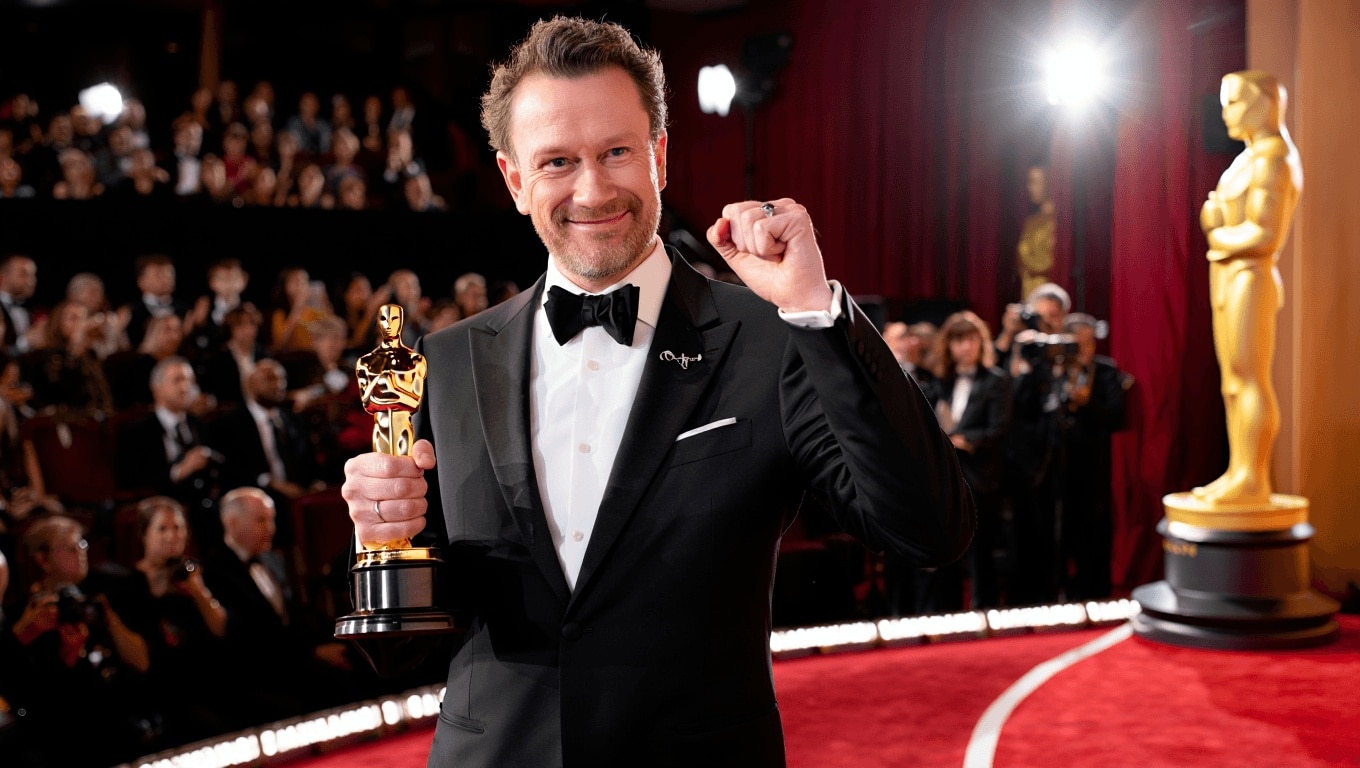
Ludwig Göransson won the Academy Award for Best Original Score at the 2026 Oscars for the film Sinners, his third Oscar and fifth nomination overall. The victory crowned a film that led this year’s ceremony with a record 16 nominations and underlined the central role music played in its global impact.
Göransson collected the statuette onstage at the Dolby Theatre after it was handed to him by the reunited cast of Bridesmaids. In his remarks he traced the origins of his musical life to his father’s record collection and recalled being given a guitar as a child — a turn that eventually brought him to the United States and into a long-running creative partnership with director Ryan Coogler.
The Best Original Score category was competitive, featuring established film composers and newer voices. The nominees were:
- Ludwig Göransson — Sinners (winner)
- Alexandre Desplat — Frankenstein
- Jerskin Fendrix — Bugonia
- Jonny Greenwood — One Battle After Another
- Max Richter — Hamnet
Sinners converted most of its attention into four Oscars: Best Actor (Michael B. Jordan), Best Original Screenplay (Ryan Coogler), Best Cinematography (Autumn Durald Arkapaw) and Best Original Score. The film’s broad recognition — from performance to craft categories — signals both industry and critical embrace of Coogler’s storytelling and the design choices that shaped its atmosphere.
Göransson’s win matters beyond another trophy. He has become one of the most visible examples of how composer-director collaborations can shape a film’s identity; his scores have repeatedly been central to Coogler’s films and to how audiences remember them. For composers, this kind of recognition raises the profile of original scoring at a moment when many productions rely on existing tracks or licensed music.
Last year’s award for Best Original Score went to Daniel Blumberg for his work on Brady Corbet’s The Brutalist — a win that highlighted a different trend, with an indie-rock background translating into a major film score. The back-to-back acknowledgments of Göransson and Blumberg suggest the Academy is open to composers who cross genres and bring nontraditional influences into cinematic scoring.
What this could mean for listeners and filmmakers: film music is increasingly treated as a narrative element rather than background texture. That shift affects how films are edited and marketed, and it can create new opportunities for musicians who want to move into scoring.
On the night, Göransson’s acceptance and the film’s haul reinforced a simple point — when a movie’s creative elements align, from screenplay to sound to performance, the awards season outcome often follows. For viewers, the payoff is a movie whose every element, including its score, works together to define the story’s tone and reach.
Similar Posts
- Oscars 2026 winners announced: full list and key takeaways
- Oscars 2026: live performance of I lied to you features Miles Caton, Raphael Saadiq
- Wendi McLendon-Covey reveals reason for skipping Bridesmaids reunion at 2026 Oscars
- Oscars 2026 winners revealed, One Battle After Another and Frankenstein land top prizes
- Oscars ratings plunge 9% to 17.86 million: lowest audience in four years

Hello, I’m Atlas. I explore the latest musical releases for you and guide you to your next sonic favorites.