
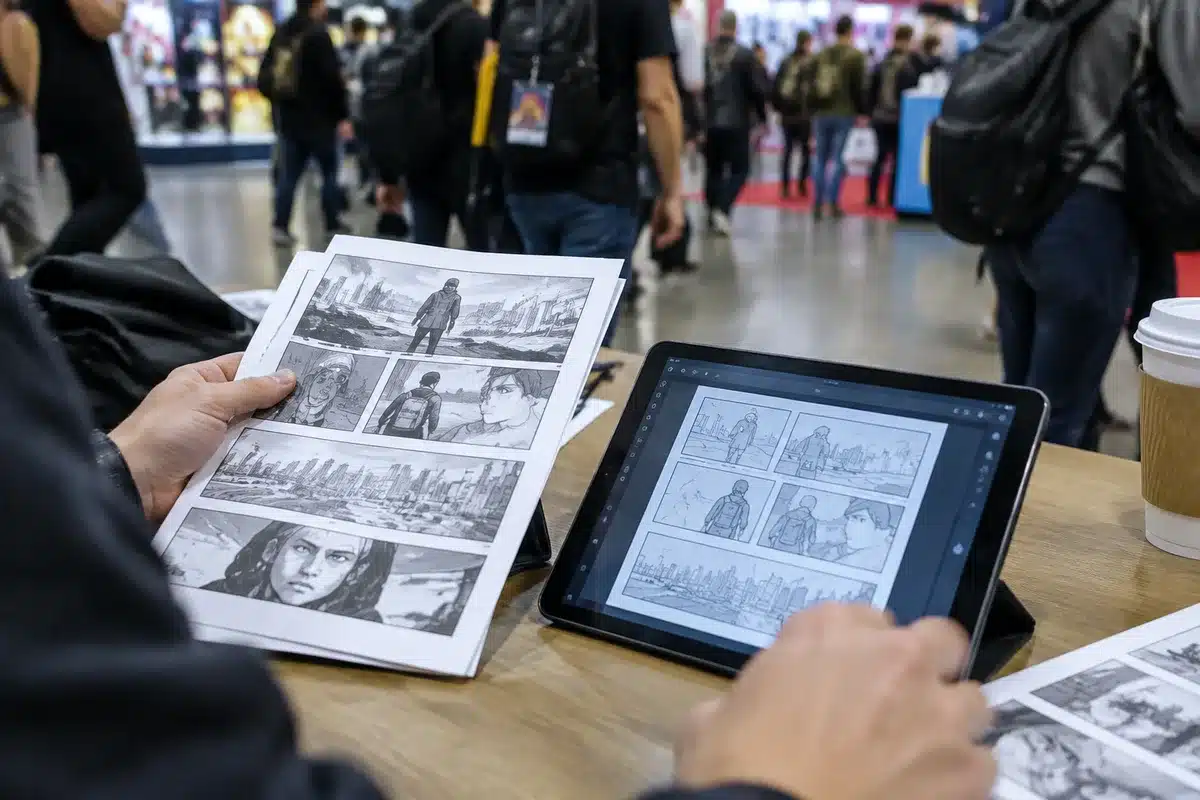
Conversations about artificial intelligence are no longer theoretical in the comics world — they are unfolding on convention stages and at Europe’s largest book fair, and the stakes are immediate for creators, publishers and readers. At New York Comic Con and the Frankfurt Book Fair this week, industry leaders and startups offered sharply different answers to who owns artwork, who gets paid, and how quickly projects can move from script to shelf.
Panels at New York Comic Con have foregrounded the legal gray zone around **generative AI**, bringing lawyers, publishers and creators together to map risk. Sessions such as “Defining the Author: Mitigating Legal Risk in AI-Generated Works” and “From Script to Shelf: New Developments in Comic Book Publishing Law” zero in on authorship, documentation of AI use, contract language and infringement exposure — topics that matter now because companies are experimenting with these tools in active production pipelines.

Across the Atlantic, a Singapore-based startup, Novvel, is promoting an AI-driven production model at the Frankfurt Book Fair and in interviews with trade press. Executives there say their platform ingests a manuscript, produces a visual storyboard that they estimate is roughly 60–70% of a finished graphic novel, and then relies on human editors and artists to finish the work. The pitch: faster turnaround and lower budgets for titles that might otherwise never reach print.
That promise comes with immediate friction. Creators on stage and in conversation have raised two core concerns: first, many AI systems are trained on existing works scraped from the web without explicit permission or compensation to original artists; second, under current legal interpretations a wholly AI-generated image may not qualify for copyright protection, complicating how publishers secure exclusive rights or franchise-level character control.
The Novvel team acknowledges some limits to the technology. They say they avoid reproducing established styles outright — citing cases where clients request looks reminiscent of classic strips — and instead have illustrators design an original template that the system can emulate at scale. In practice, that often means a human artist sets the core character design, then AI tools generate variations and bulk pages.
For many creators, that workflow raises a simple question: does one page of commissioned art become the legal and economic foundation for hundreds of AI-generated pages? And if the underlying training data includes uncredited works, what are the creators owed?
How the debate breaks down
- Creative control: Publishers want reproducible, exclusive characters for branding; artists worry about losing ownership and future earnings.
- Copyright status: Human-authored sequencing and editorial choices are likely protectable, but images generated purely by algorithms remain legally uncertain in many jurisdictions.
- Economic impact: Startups claim dramatic cost and time reductions, potentially broadening what gets published — but also pressuring traditional paying models for illustrators and inkers.
- Ethical and reputational risk: Companies and vendors using questionable imagery can face public backlash, complicating sales and partnerships.
Industry responses are uneven. Some publishers are drafting explicit clauses to document AI use, define contribution levels, and secure rights; others are exploring “AI-assisted” credits to preserve copyright chains. Legal advisers at the conventions urged clear record-keeping — who prompted an image, who edited it, what human creative decisions were applied — as the most practical way to limit litigation risk today.
There are also editorial implications. One founder described using public-domain texts — such as 19th-century short stories — to prototype full-length graphic anthologies, which avoids some training-data disputes but does not address the larger market effect. Others are experimenting with hybrid workflows: a human author sequences the narrative and provides the artistic brief, while algorithms handle background fills or produce multiple thumbnail variations for editors to choose from.
Back on the NYCC floor, controversy has erupted in spots over vendors and promotional material perceived as relying too heavily on AI outputs. That public scrutiny is already shaping how conventions and retailers vet exhibitors, and it could influence contract terms between publishers and platform vendors.
What to watch next
- Legal rulings and government guidance on whether and how AI-generated images can receive copyright protection.
- Publishing contracts that explicitly allocate rights, revenue shares, and credit when AI tools are used.
- Industry standards or labeling practices for works produced with AI assistance — both for transparency and consumer trust.
- Market reactions from creators: unionization, collective bargaining over AI use, or new licensing models.
The debate is not merely technical: it affects who benefits from derivative works, how culture is stewarded, and what kinds of stories are economically viable. As conventions and fairs place AI at the center of conversations, creators and companies are being forced to negotiate the balance between efficiency and artistic, legal and moral accountability — and those negotiations will determine how quickly, and in whose interests, an AI-assisted future arrives in comics and graphic novels.
Similar Posts
- SZA, Kenneth Blume demand answers after AI scraped their music
- Jodie Foster questions AI use in F1 film: sparks debate over authenticity
- Copyright Office solicits comment on music streaming fraud in US
- Rob Liefeld signals a new Superman comic could already be in the works
- Pixar animator Bobby Podesta signs new deal with First Second for Tomorrow

Hello, I’m Jax. I guide you through the latest comics releases and enrich your geek universe.