
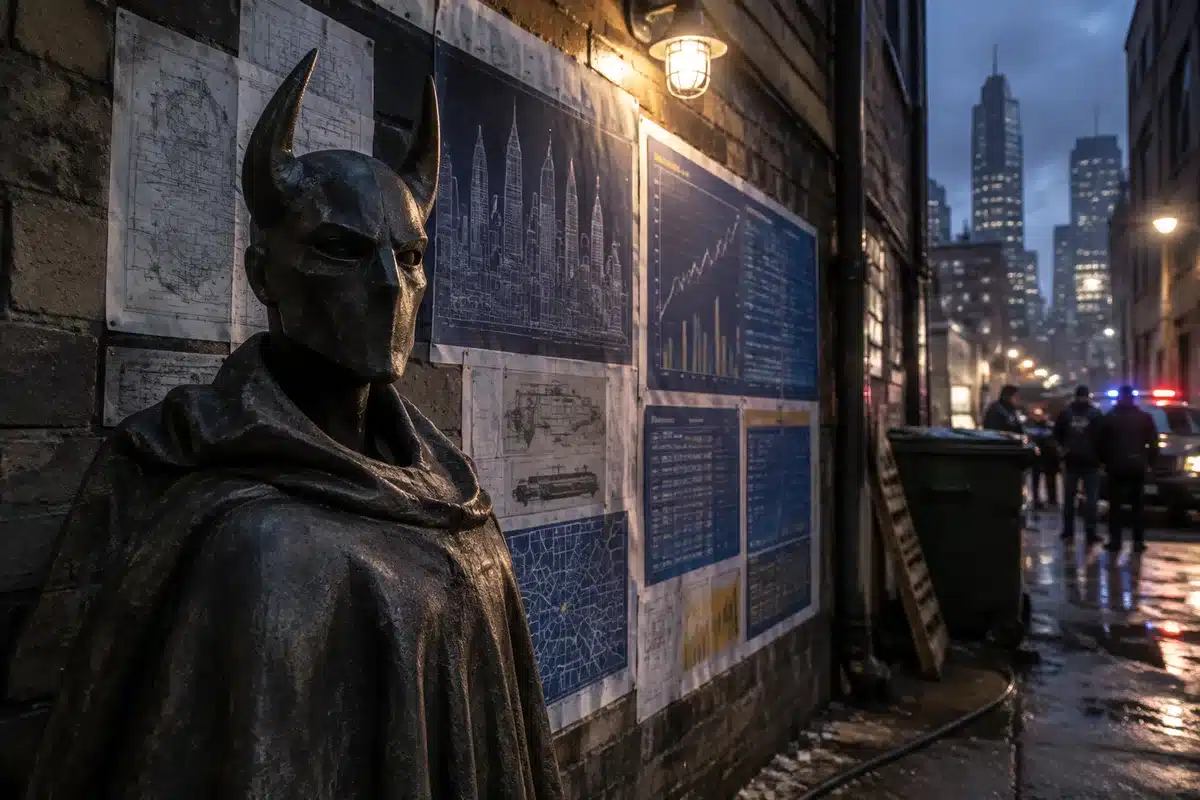
DC’s Batman 2026 Annual, out today, quietly reframes two familiar figures — the masked Minotaur and the hacker-accountant Noah Kuttler, aka the Calculator — into a single, consequential narrative about order, algorithms and organized crime. The issue matters now because it ties recent Gotham storylines together and casts the city’s criminal networks in the language of data and markets, raising fresh stakes for Bruce Wayne and his allies.
Written by Matt Fraction with art by Brian Ching and Jesse Lonergan, the annual interleaves origin moments for both men while pushing a central motif: patterns in nature and numbers in the city mirror one another. That structural idea becomes the comic’s engine, guiding how the plot unfolds and how alliances are formed.
Two origin stories, one design
The issue alternates between the Minotaur’s rise — presented here as a brutal, pragmatic force who seeks to impose a new order on Gotham’s underworld — and the backstory of Noah Kuttler, who is shown as a frightened child and later a calculating adult. Kuttler’s childhood, cut short by extreme controlling measures, is used to explain both his genius and his warped relationship to power.

Rather than a simple villain origin, Fraction frames these sequences as mirrors: a macro strategy imposed on a chaotic city and the micro-level traumas that produce a man who counts everything. The narrative tone is clinical at times, emotional at others — a blend that keeps both human cost and strategic ambition in view.
Algorithmic crime and capitalist logic
One of the script’s clearest critiques is aimed at the language of modern capitalism. The Minotaur — here sometimes called Max — treats Gotham’s crime syndicates like a portfolio, applying venture-style tactics to extract profit and impose control. The Calculator supplies the arithmetic: logistics, risk analysis and predictive measures that make criminal operations more efficient and, crucially, more dangerous.

That marriage of brute force and data-driven planning changes what “organized crime” looks like in Gotham. It’s less about turf wars and more about optimization: reward systems, punishments for deviation, and a top-down algorithm that balances risk and gain for the families under the Torus.
- Core players: The Minotaur (Max), Noah Kuttler (Calculator), Gotham crime families, and Batman as the opposing variable.
- Creative team: Matt Fraction (writer), Brian Ching (lead art), Jesse Lonergan (additional art).
- Central motifs: Pattern and proportion (evoked through the idea of the Golden Ratio), market metaphors, and surveillance-style tactics.
- Why it matters: Recasts familiar antagonists as a coordinated threat using analytics and capital incentives, forcing Batman to adapt.
The issue doesn’t ignore Batman’s other pressures. While Gotham’s protector is distracted by external threats and parallel crises — assassins targeting Bruce Wayne, and other crossover events — Fraction uses those complications to show how a coordinated criminal strategy can exploit openings in the city’s defenses.
Calculator: a long and shifting history
Noah Kuttler’s character has been reinterpreted several times since his debut. Created in the mid-1970s as a costumed foe who used a numerical interface to generate constructs and anticipate opponents, he later evolved into a behind-the-scenes information broker. That reinvention turned him into a tactical asset for other villains: a source of logistics, weapons advice and real-time intelligence.
On screen and in animation he’s appeared in multiple forms — from live-action cameos to voice roles — and this Annual positions him again as an expert operator, but one who must choose whether to remain a tool or to assert his own agency under the Minotaur’s umbrella.
What the issue does well — and what it asks readers to watch for
Visually, Ching and Lonergan emphasize the contrast between the Minotaur’s physical menace and the Calculator’s clinical precision. The story rewards close reading: repeated images and refrains hint at future reveals, and the mathematical metaphors invite readers to track how small actions ripple outward.
But the comic also raises an open question: will Kuttler’s calculations be enough to contain the human cost of Max’s ambitions? The Annual deliberately leaves some outcomes unresolved, setting the stage for follow-ups in the main Batman run.
For readers following Fraction’s arc since Batman #1, this installment functions as both explanation and escalation. It answers how the Torus came to dominate Gotham’s underworld and suggests what the city might look like if crime is run like a hostile investment fund.
Batman 2026 Annual #1 (written by Matt Fraction; art by Brian Ching and Jesse Lonergan) is published by DC Comics today. The issue lists a cover price of $5.99 and carries the creative credits prominently, as part of a larger storyline that has been building across recent issues.
Similar Posts
- Batman #10 confronts capitalism: what readers need to know
- Batman Justice Year revealed: Williamson and Redondo to launch gritty new run
- Batman #13 preview images drop, plus Bad Seeds Sunset and Poison Ivy #48 glimpses
- Matt Fraction at NYCC vows to take down billionaire icons: Bruce Wayne targeted
- Caped Crusader season 2 release month: Adults set to return and other key TV dates

Hello, I’m Jax. I guide you through the latest comics releases and enrich your geek universe.